Which Best Native Australian Trees for Memorials?
Key Takeaways
|
Quick Comparison: Native Memorial Trees
| Tree | Lifespan | Height | Flowers | Best For |
| Lemon Scented Gum | 100+ years | 20 to 35m | White (summer) | Maximum longevity, large spaces |
| Flowering Red Gum | 80 to 150 years | 8 to 15m | Red, orange, and pink (summer) | Long life with vibrant colour |
| Bottlebrush | 20 to 50 years | 3 to 8m | Red (spring into summer) | Attracting native birds |
| Golden Wattle | 10 to 15 years | 4 to 8m | Yellow (August to September) | National symbolism, companion planting |
| Flame Tree | 50 to 100 years | 10 to 20m | Red (November to December) | Bold summer statement |
| Queensland Kauri | 200+ years | 30 to 50m | N/A | Ultimate longevity, large spaces |
| Wollemi Pine | 500+ years | 25 to 40m | N/A | Rare, prehistoric significance |
Introduction
Choosing a memorial tree is not a small decision. Most families want a tree that will outlive them, one that grows without constant attention and genuinely suits the Australian climate. The problem is that not every tree does this well. Some species might look healthy for a few years but then struggle once they’re established in heavy clay soils or hot inland conditions. Others require ongoing care that a memorial site cannot always guarantee.
This guide walks you through the native Australian memorial trees available at Mornington Green Living Legacy Gardens. It covers lifespan, size, flowering times, wildlife value, soil requirements, and cultural significance. Whether you’re planning ahead or choosing a tree for a loved one today, this guide will help you make an informed decision.
Gum Trees (Eucalyptus): The Long-Term Anchor
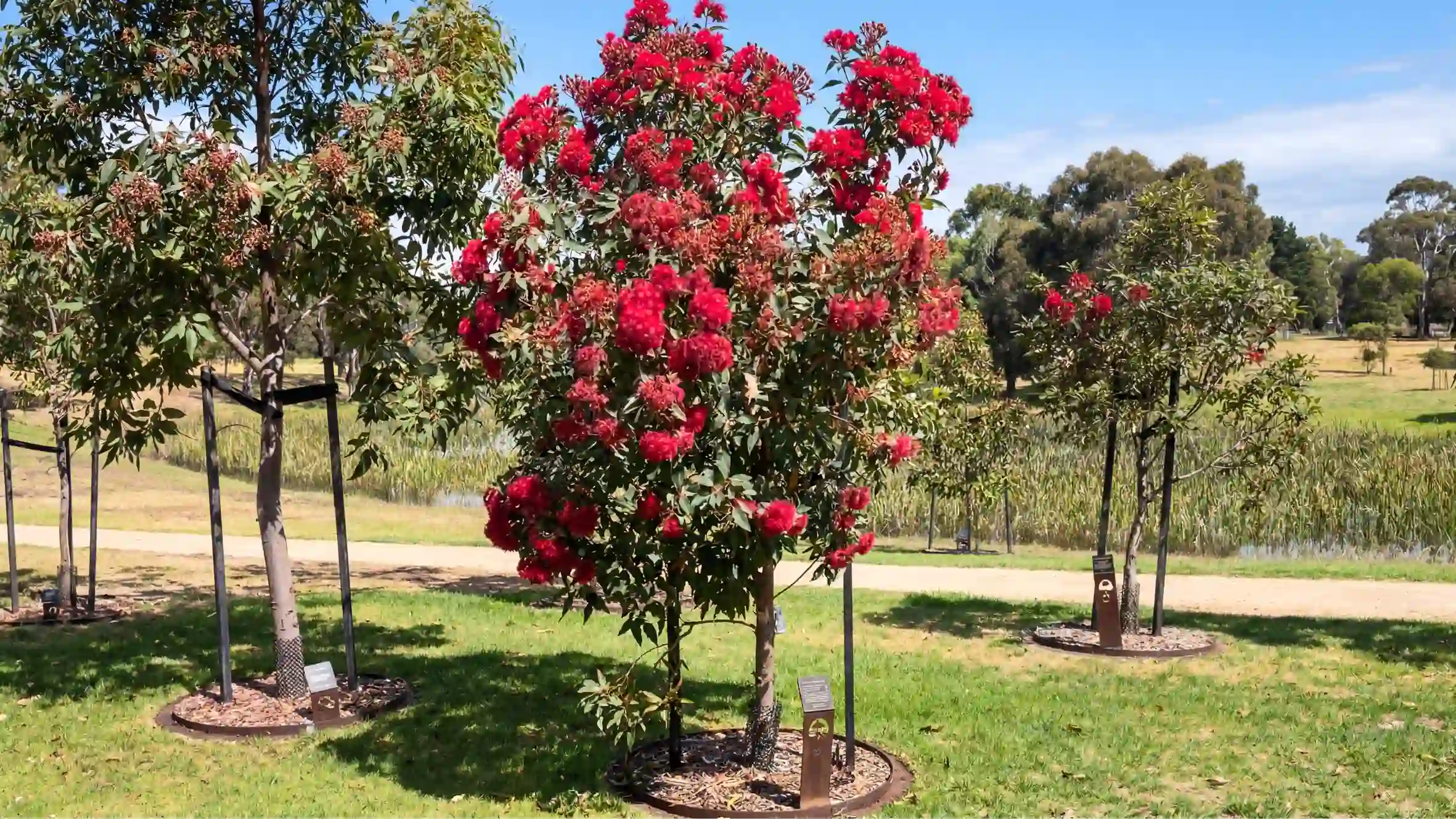
Gum trees, scientifically known as Eucalyptus and Corymbia, are the most dependable native choice for a memorial tree with a lifespan measured in generations. They’re iconic to the Australian landscape and offer the longest lifespans of any native flowering trees.
Flowering Red Gum (Corymbia ficifolia)
Category at Mornington Green: Large (up to 5 infusions)
| Attribute | Detail |
| Lifespan | 80 to 150 years |
| Height | 8 to 15 metres |
| Spread | 5 to 10 metres |
| Flowers | Vibrant red, orange, or pink clusters |
| Flowering season | December to February (summer) |
| Growth rate | Moderate, around 30 to 50cm per year once established |
| Soil | Well-drained, tolerates clay-loam |
| Drought tolerance | High once established (2 to 3 years) |
Why families choose it: Flowering Red Gum offers the rare combination of long lifespan and spectacular seasonal colour. The vivid summer blooms attract nectar-feeding birds, so each visit becomes a chance to see wildlife activity around the tree. Its compact size compared to other gums also makes it a good fit for suburban memorial gardens.
Your guide to a living memorial
Download our free brochure to explore tree varieties, planting locations, and how a memorial tree can become a lasting place for remembrance.
Best for: Families wanting longevity plus vibrant flowers, especially on sites with moderate space.
Pink Flowering Yellow Gum and Flowering Orange Gum
These are colour variants of the Corymbia family and share the same characteristics as Flowering Red Gum, just with different flower tones. You can choose based on colour preference or personal significance. Pink tends to carry a sense of softness while orange brings warmth.
Lemon Scented Gum (Corymbia citriodora)
Category at Mornington Green: Extra Large (up to 8 infusions)
| Attribute | Detail |
| Lifespan | 100+ years |
| Height | 20 to 35 metres |
| Spread | 10 to 15 metres |
| Bark | Smooth, pale white to pink that sheds in summer |
| Leaves | Lemon-scented when crushed |
| Flowers | White clusters (less showy than Flowering Gums) |
| Flowering season | Summer |
| Growth rate | Fast, around 50 to 100cm per year |
| Soil | Adaptable, prefers well-drained |
| Drought tolerance | Very high |
Why families choose it: The Lemon Scented Gum is a truly majestic tree. Its smooth, pale trunk glows in morning and evening light, and the citrus-scented leaves add a sensory element to every visit. This is the tree for families who want maximum longevity and a commanding presence in the landscape.
Best for: Large memorial spaces, particularly for families prioritising a tree that will stand for over 100 years.
Bottlebrush (Callistemon): The Native Wildlife Magnet
Category at Mornington Green: Large (up to 5 infusions)
| Attribute | Detail |
| Lifespan | 20 to 50 years |
| Height | 3 to 8 metres |
| Spread | 2 to 5 metres |
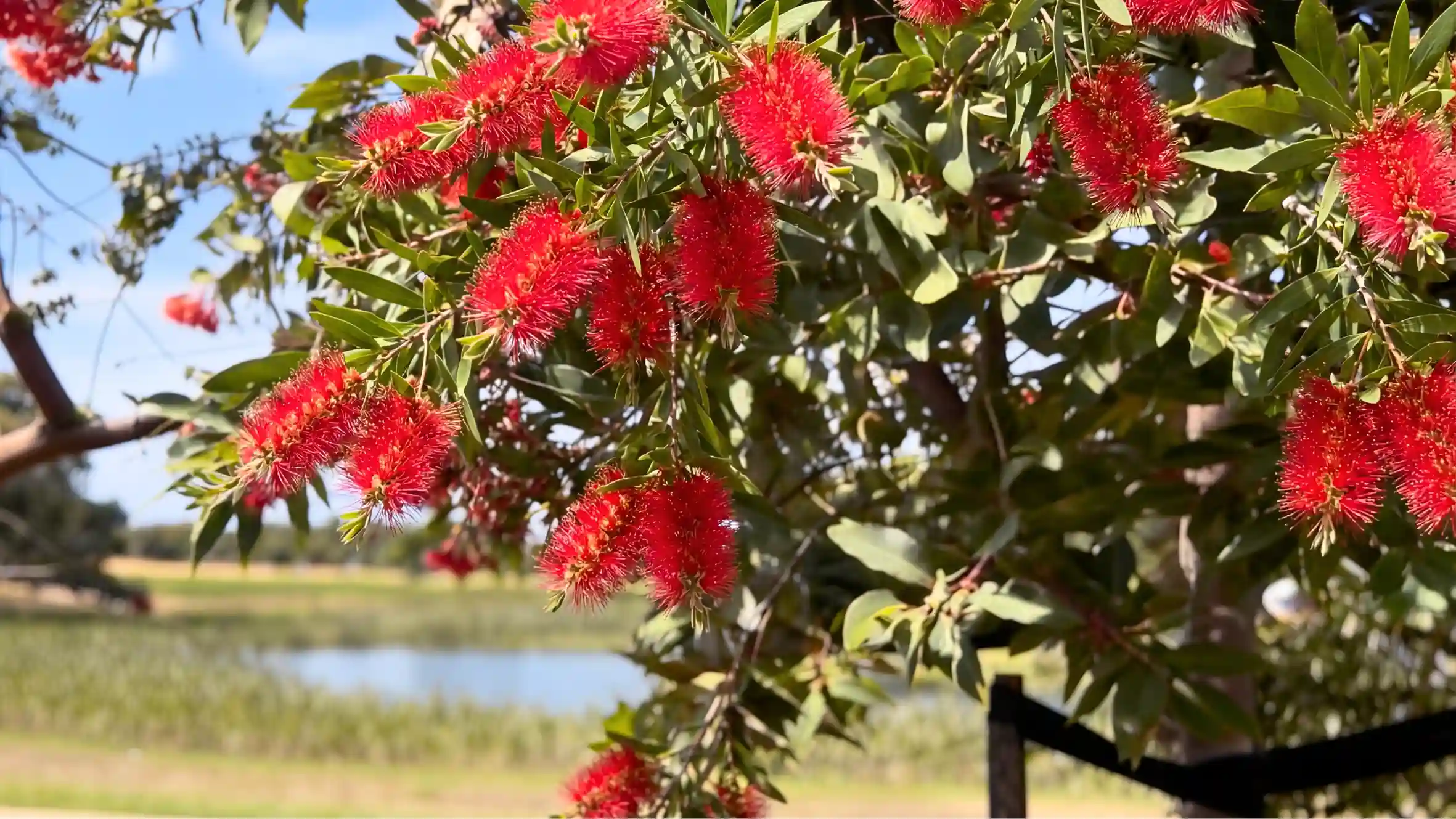
| Flowers | Distinctive red “brush” spikes |
| Flowering season | September to January (spring through summer) |
| Growth rate | Moderate to fast, around 30 to 60cm per year |
| Soil | Highly adaptable, tolerates clay, sand, and some salt |
| Drought tolerance | High once established |
| Wildlife | Honeyeaters, lorikeets, native bees |
Bottlebrush is one of Australia’s most recognisable native plants. It gets its name from the cylindrical flower spikes that look just like a traditional bottle brush. The nectar-rich flowers attract native birds reliably each season, which gives families something to look forward to during visits.
Fire adaptation: Like many Australian natives, Bottlebrush has adapted to fire. The woody seed capsules remain on the plant for years and only release seeds after fire or when the plant dies. This resilience carries symbolic meaning too, because it represents life renewing after hardship.
Why families choose it: For families who want their memorial tree to be alive with wildlife activity, Bottlebrush delivers. The annual flowering provides a seasonal marker, and the visiting birds bring a sense of life and continuity to the space.
Best for: Families wanting bird activity and seasonal colour, particularly in smaller to medium spaces.
Golden Wattle (Acacia pycnantha): Australia’s Floral Emblem
Category at Mornington Green: Small (1 infusion)
| Attribute | Detail |
| Lifespan | 10 to 15 years |
| Height | 4 to 8 metres |
| Spread | 3 to 5 metres |
| Flowers | Bright golden yellow, fragrant |
| Flowering season | Late August to September (late winter into early spring) |
| Growth rate | Fast, up to 1 metre per year |
| Soil | Adaptable, tolerates poor soils |
| Drought tolerance | Very high |
| Special feature | Nitrogen-fixing roots that improve surrounding soil |
Golden Wattle was proclaimed Australia’s national floral emblem on 1 September 1988. It appears on the Australian Coat of Arms and is the reason 1 September is celebrated as National Wattle Day. For many families, this national significance adds a meaningful layer to their memorial.
The honest reality: Wattle is not built for permanence as a standalone memorial. A 10 to 15 year lifespan means it will not outlast the generation that planted it. However, its fast growth means it provides beauty quickly, and its nitrogen-fixing roots actively improve the soil for surrounding trees, so it still plays an important role.
Companion planting: Many families choose Golden Wattle alongside a longer-lived Eucalyptus or Bottlebrush. The Wattle provides early colour and ground improvement while the main memorial tree establishes itself.
Why families choose it: It carries strong national symbolism, puts on a brilliant spring display, establishes quickly, and is especially meaningful for late winter or spring anniversaries.
Best for: Companion planting alongside longer-lived trees, and for families with meaningful dates in August or September.
Other Native Options at Mornington Green
Flame Tree (Brachychiton acerifolius)
Category: Extra Large (up to 8 infusions)
| Attribute | Detail |
| Lifespan | 50 to 100 years |
| Height | 10 to 20 metres |
| Flowers | Brilliant red bell-shaped clusters |
| Flowering season | November to December |
The Flame Tree makes a bold statement. When it flowers in late spring and early summer, the entire canopy can turn red and becomes visible from a distance. It’s native to eastern Australian rainforests and is a great choice for families who want their memorial to truly stand out.
Queensland Kauri (Agathis robusta)
Category: Extra Large (up to 8 infusions)
| Attribute | Detail |
| Lifespan | 200+ years |
| Height | 30 to 50 metres |
| Characteristics | Towering with a straight trunk and dense crown |
For ultimate longevity, the Queensland Kauri is unmatched among the offerings at Mornington Green. This ancient species is native to Queensland rainforests and can live for centuries, making it a choice for families who want a tree that will stand for generations well beyond their own.
Wollemi Pine (Wollemia nobilis)
Category: Extra Large (up to 8 infusions)
| Attribute | Detail |
| Lifespan | 500+ years (the species is 200 million years old) |
| Height | 25 to 40 metres |
| Characteristics | Known as a “living fossil” with bubbly bark and ancient lineage |
The Wollemi Pine was thought to be extinct until it was discovered in 1994 in a remote canyon in New South Wales. It dates back to the time of dinosaurs, making it a true “living fossil.” For families seeking something profoundly rare that symbolises endurance through time, there really is no other tree like it.
Indigenous and Cultural Significance
Native Australian trees carry deep cultural meaning for First Nations peoples, developed over tens of thousands of years.
Gum trees provided medicine in the form of eucalyptus oil for respiratory ailments, along with tools such as bark for coolamons and canoes, and even food like lerp, which is a sweet substance produced by insects on leaves. The trees also served as meeting places, boundary markers, and sites of ceremony.
Wattle was a source of food because the seeds could be ground into flour. It also provided medicine since the gum was used to treat wounds, and the wood was used for tools like spears and boomerangs. The flowering of wattle signalled seasonal changes as well. When wattle bloomed, communities knew certain fish were running or that it was time to move camp.
Bottlebrush provided nectar as a sweet drink and medicine from its leaves. The flowers were soaked in water to create a refreshing sweet beverage.
At Mornington Green, we acknowledge that the land on which our gardens stand has been cared for by Aboriginal peoples for millennia. The native trees we plant continue a living connection to country.
Which Tree Suits Your Memorial?
Use this guide to narrow your choice:
- If you want maximum lifespan (100+ years): Lemon Scented Gum or Queensland Kauri
- If you want longevity plus vibrant flowers: Flowering Red Gum (summer) or Flame Tree (late spring)
- If you want to attract native birds: Bottlebrush
- If you want national symbolism: Golden Wattle (best as companion to a longer-lived tree)
- If you have a meaningful date: Match the flowering season to that date. Wattle blooms in August and September. Bottlebrush flowers from September through to January. Flowering Red Gum blooms from December to February. Flame Tree flowers in November and December.
- If you want something truly rare: Wollemi Pine
The Science of Ashes and Trees
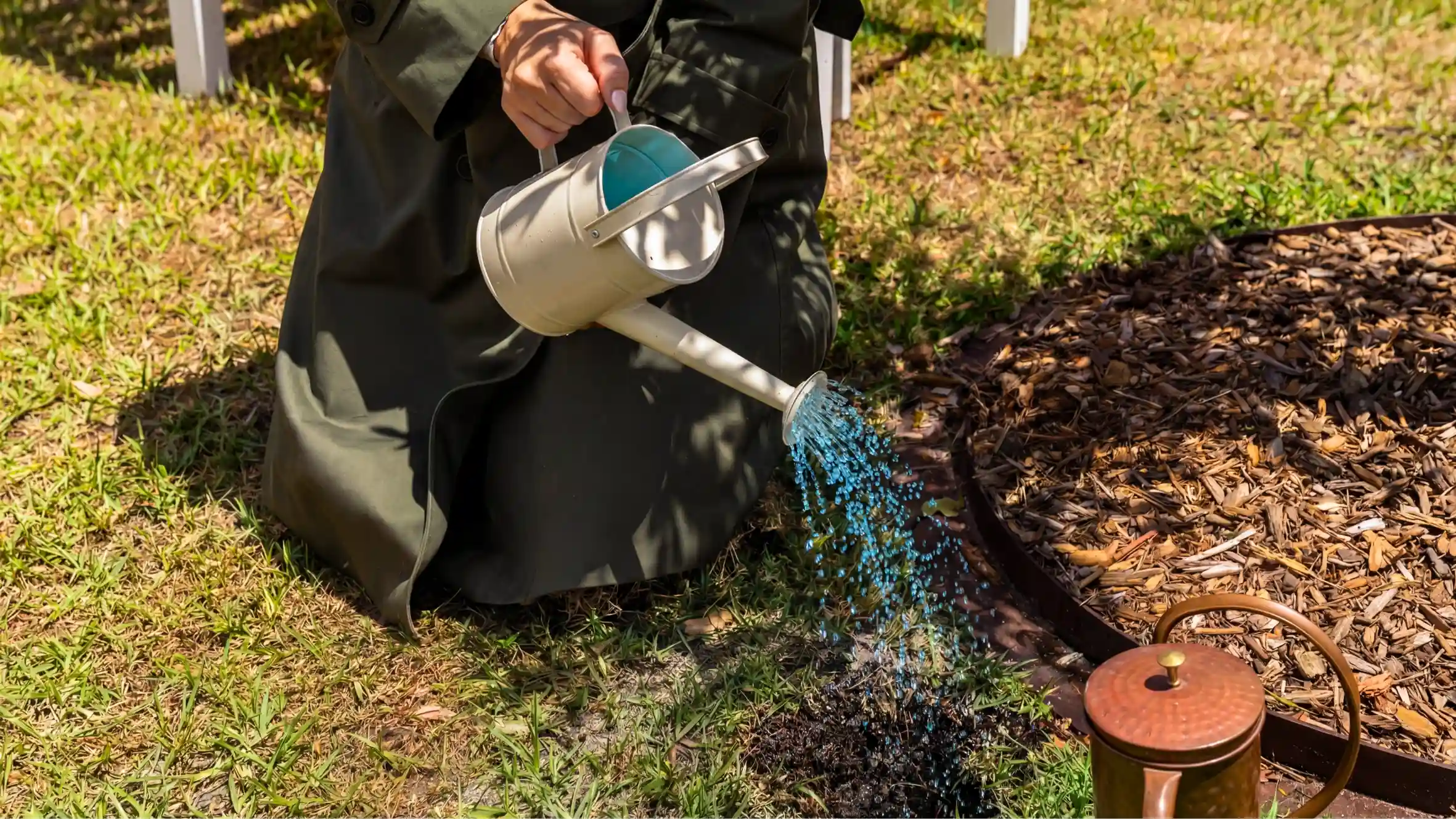
One question families often ask is whether cremated ashes can be placed directly with a memorial tree.
The honest answer is no, not without treatment.
Cremated remains have a pH of 11 to 12, which is extremely alkaline and similar to bleach. They also contain high levels of sodium. If untreated ashes are placed directly with a tree, they will damage root systems, prevent nutrient absorption, kill surrounding vegetation, and create “dead zones” in the soil.
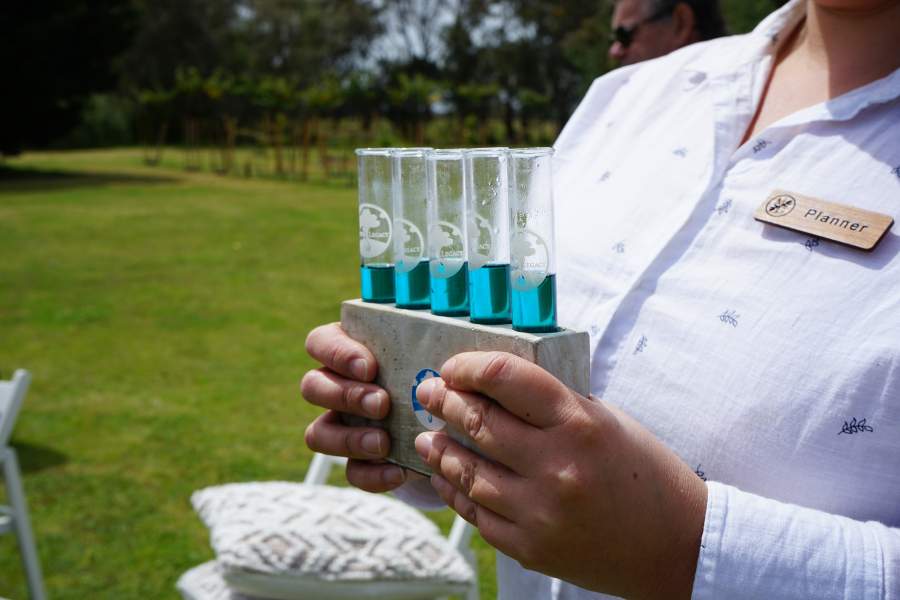
At Mornington Green, we use a specialist Living Legacy Formula that transforms cremated remains into plant-available nutrients. The treatment neutralises harmful alkalinity, reduces sodium to safe levels, and converts calcium and phosphorus into forms that trees can actually absorb.
This process is the same one used by local and state government cemeteries across Australia. It ensures the ashes genuinely nourish the tree rather than harm it.
Frequently Asked Questions
What is the longest-lived native Australian tree for a memorial?
Among flowering natives, Lemon Scented Gum can live well beyond 100 years. For ultimate longevity, Queensland Kauri (200+ years) and Wollemi Pine (500+ years) are also available at Mornington Green, though they don’t produce showy flowers.
Is Golden Wattle a good memorial tree?
Golden Wattle is deeply meaningful as Australia’s floral emblem, but it has a lifespan of only 10 to 15 years. It works best as a companion planting alongside a longer-lived tree like Flowering Red Gum or Bottlebrush.
Which native memorial tree attracts the most birds?
Bottlebrush (Callistemon) is the standout for bird activity. Its nectar-rich flowers attract honeyeaters, lorikeets, and other native birds throughout spring and summer.
When do native memorial trees flower?
Golden Wattle blooms in late August through September. Bottlebrush flowers from September to January. Flowering Red Gum blooms from December to February. Flame Tree flowers in November and December. Lemon Scented Gum flowers in summer, though its blooms are less showy.
Can I incorporate cremated ashes into a native memorial tree?
Yes, but only with proper treatment. Untreated ashes are highly alkaline and high in sodium, which damages trees. Mornington Green uses a specialist treatment process that converts remains into safe, plant-available nutrients.
How do I choose between trees at Mornington Green?
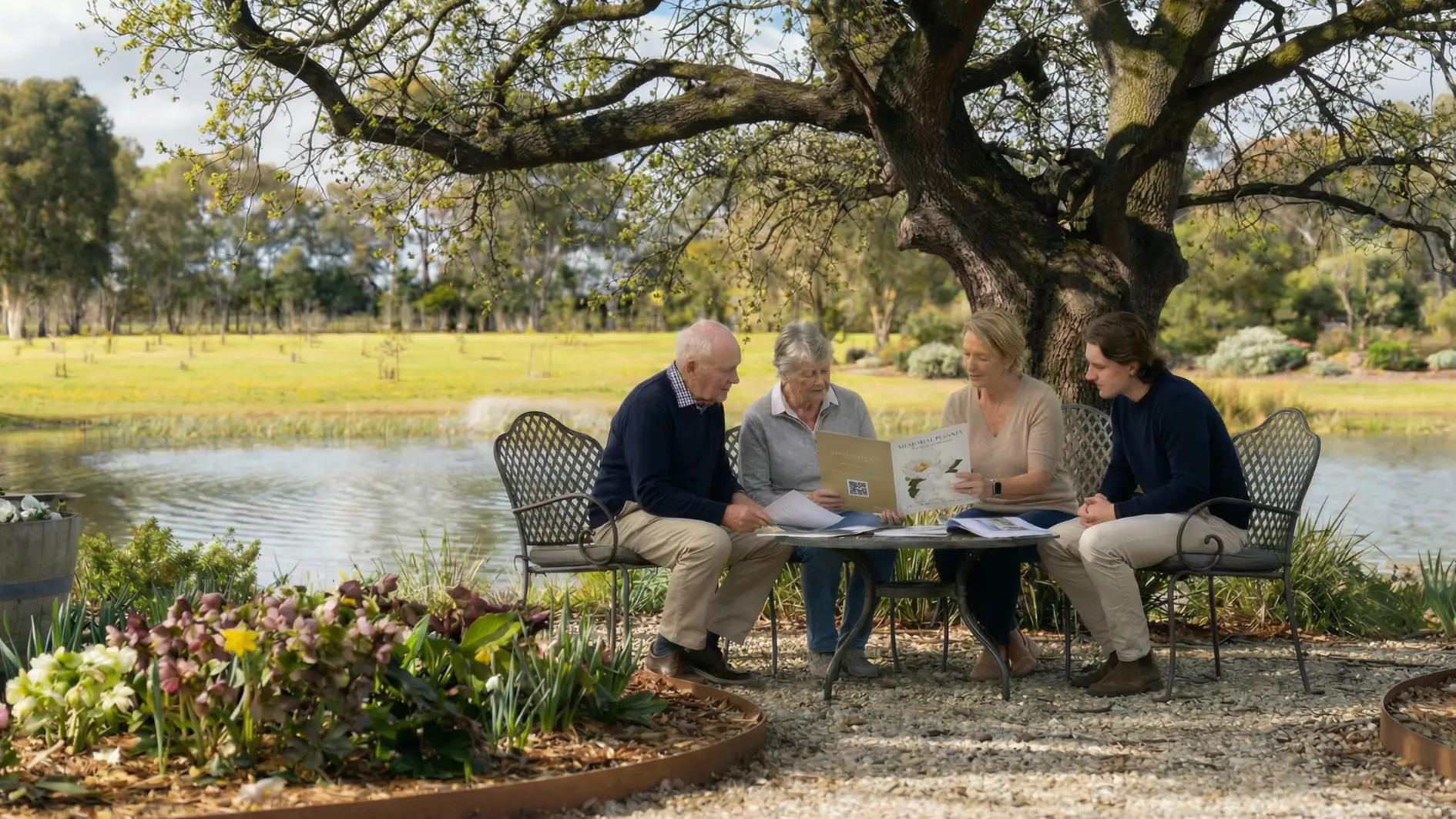
Think about your desired lifespan, which flowering season and colour appeal to you, how much space is available, and whether wildlife activity matters. Our horticulture team can guide you through everything during a garden tour.
Visit Mornington Green
Mornington Green Living Legacy Gardens is located at 125 Tyabb-Tooradin Road, Somerville, Victoria, roughly 60 kilometres from Melbourne CBD.
The garden holds 26 native and ornamental tree species, each matched to the Peninsula’s soils and climate. Families can arrange a private tour to walk among established trees, see the different species in person, and ask questions before making any decision.
Contact:
- Phone: (03) 9059 4959
- Email: contact@morningtongreen.com.au
- Website: morningtongreen.com.au